BREAKING
WIREOPENAI CLAIMS NAVIER–STOKES. CLAY HAS NOT.
~10k agents, ~88h, Lean formalization. Statements C/D claimed. Prize untouched. Bridson unhurried.
Desk file · 10 SEP 2026 · 00:55 GMT
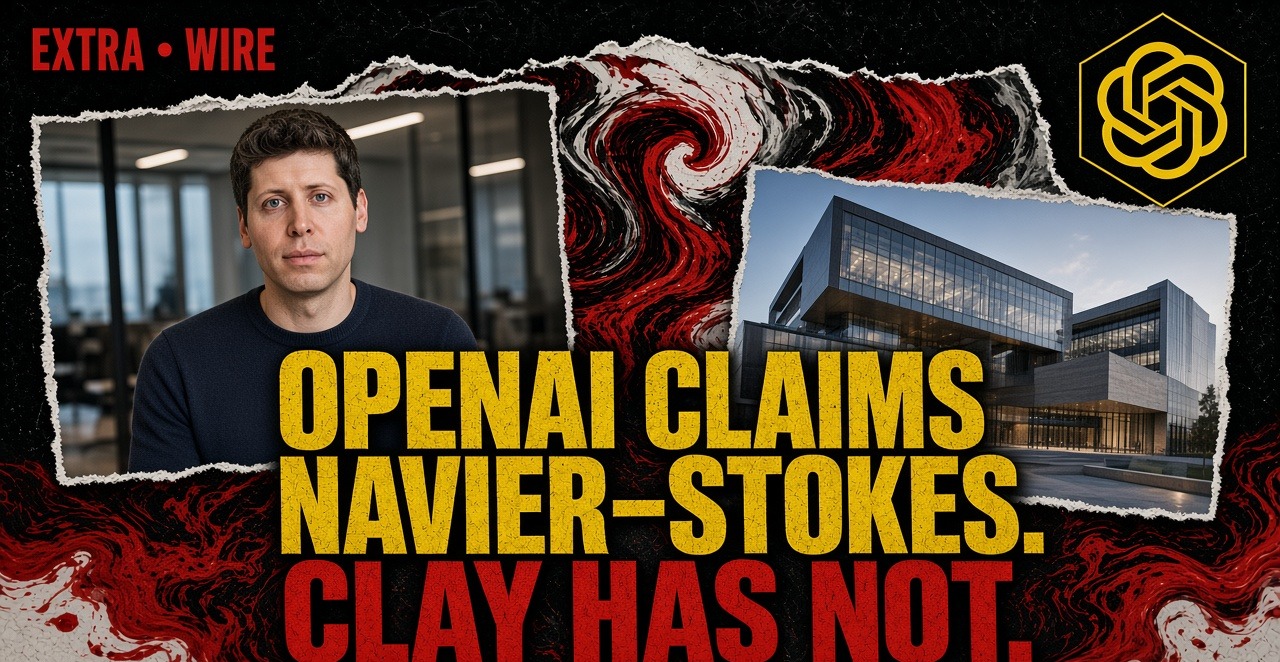
Collage: Sam Altman — Amos Ben Gershom / GPO Israel (CC BY-SA 3.0); Andrew Wiles Building — Alain Goriely (CC BY-SA 3.0); OpenAI mark (PD-textlogo/trademark). Not Clay acceptance.
TECH DESK — OpenAI says an internal system cracked a 90-year-old fluid-math question in under four days of agent run-time. The Clay Mathematics Institute has not accepted that claim. The company says it will not chase the million-dollar Millennium Prize. Extra files the split: company release versus prize status. Do not read this Extra as “AI solved all math.” One company claim. Two statements of one Millennium problem. Prize status unchanged.
On 8 September 2026, OpenAI published “On the Navier–Stokes Millennium Prize Problem.” An internal model — described as significantly more capable than GPT-6 Astra — drove a multi-agent search that produced an analytical proof plus a Lean formalization. Number first, from the company: on the order of ~10,000 concurrent agents on the Navier–Stokes track; agents reached a resolution on Saturday, 5 September, about 88 hours after launch on 1 September; Lean formalization and verification took roughly 17 more hours via GPT-6 Astra; for Navier–Stokes alone, about 2.7 million agent messages and ~130 billion output tokens. Those counts are CONFIRMED as OpenAI’s numbers, not as independent measurement.
OpenAI frames the result as a finite-time singularity: smooth three-dimensional incompressible flow, with a smooth external force, can blow up while energy stays finite. The company says that establishes statements C and D in Clay’s official formulation — not A/B global-smoothness proofs. Write-up and Lean links sit on openai.com; Extra does not paste them. On money the company is explicit: “We do not intend to claim the Millennium Prize for this result.” Stated goal: report model progress, not take the Clay check. RANGE: Clay acceptance — NOT granted.
What Clay has not done is the brake on this Extra. BBC’s Kali Hays wrap lands it: OpenAI’s solution has yet to be verified independently or publicly accepted by Clay. The institute still lists Navier–Stokes among open Millennium problems. Martin Bridson, Clay’s president, called the announcement exciting and said evaluation will be “deliberately unhurried” and “absolutely rigorous” (Implicator wrap citing Bridson). Process language, not acceptance. Peer review still ahead. CONFIRMED: Bridson’s attributed process stance. UNVERIFIED: Clay accepts the proof or lists the problem solved.
Provenance dispute — named, not invented. OpenAI’s concurrent-work section names Tristan Buckmaster (NYU) and Levent Alpöge (Anthropic). The company says its effort began 1 September after rumors later tied to that pair; after Lean verification (6 September), it reached out believing they also had Navier–Stokes and learned they had a forced Euler resolution. OpenAI says it recognizes their priority on forced Euler. BBC reports Buckmaster went public the same day: he said he learned on 3 September that information about their progress had reached OpenAI, and that OpenAI did not start the Navier–Stokes push until after that signal. He said he had not yet read OpenAI’s full proof. Extra does not invent or reconstruct email text. No fake quotes beyond attributed public lines.
OpenAI’s denial: researchers and agents did not see the pair’s work until public release; no specific user data was accessed to solve the problem. Narrow caveat, labeled: “While unlikely, we cannot rule out that de-identified data derived from their usage of our products helped improve our models.” It says proofs differ and even the Euler results differ (forced vs unforced). RANGE: provenance / product-data spillover — disputed; company denies seeing their work; spillover flagged unlikely and unproven. No desk verdict.
Clay’s written C/D route permits a smooth force; OpenAI’s construction uses one. Many working mathematicians treat the unforced question as the harder prize of intuition. Bridson’s review will weigh that gap. Extra reports the dispute as RANGE on significance pending Clay and peers. CONFIRMED shelf: OpenAI published the NS claim and Lean links on 8 Sep 2026; ~10k agents / ~88h to agent resolution / +~17h Lean as company numbers; statements C/D (forced singularity) claimed; Bridson “unhurried / rigorous”; OpenAI will not claim the $1m prize. UNVERIFIED / NOT accepted: Clay acceptance; independent journal verification complete. FALSE framing — do not use: “AI solved all math.”
The still on this Extra is NTH MERIDIAN EXTRA hybrid journalistic art — Altman GPO still + Andrew Wiles Building + OpenAI mark collage; not a Clay prize ceremony and not an acceptance photo. VIDEO=no. Nailed down, 10 September 2026, 00:55 GMT. PATH /wire/openai-navier-stokes-millennium-claim. DESK_ID openai-navier-stokes-millennium-claim. Beat WIRE / BREAKING. Verification: OpenAI company post 8 Sep 2026 (navier-stokes-solution); BBC Kali Hays; Implicator Clay/Bridson wrap; DongA Science Clay process note — verification only, do not republish. NTH MERIDIAN does not invent emails or player quotes.
OpenAI company post 8 Sep 2026 (navier-stokes-solution); BBC Kali Hays; Implicator Clay/Bridson wrap; DongA Science Clay process note — verification only. NTH MERIDIAN does not invent emails or accept Clay status OpenAI has not been granted.